Face it, we’re better at it than you
We use AI every day, at every stage of our work. That’s exactly why we’d rather you didn’t use it to brief us.
More and more of the briefs that land in my inbox have been written by AI. You can tell. They’re tidy, well organised, perfectly reasonable, and they tell me almost nothing.
I want to be clear about where I stand before I go on, because this isn’t a piece about AI being bad. We use AI an incredible amount. We use it in ways most clients wouldn’t dream of, and it’s built into all the right points of our process. That’s exactly why I’d rather you didn’t use it to brief us.
It’s a pet peeve, I’ll admit. But it’s a pet peeve with four good reasons behind it.
1. The raw material is the brief
The best material for me to work with is raw material. In a rambling email, a voice note recorded in the car or a half-finished document, I can read things a polished brief hides: intent, priorities, how engaged you are, your voice and your tone. That’s where the real brief lives.
Most of the time, on the projects we take on, the client doesn’t actually know what they want yet. That isn’t a criticism. It’s the job. Part of the process is stripping back what you believe you want, finding the problem underneath it, and coming up with the solution you were actually looking for. Connecting with the problem and understanding it is the design process.
Do that step with AI too early, and for all its benefits, what reaches me is no longer an accurate picture of your situation. It’s been filtered. The structure of the information has changed, and so has the brief. You won’t come out of it with a clearer understanding of the problem, and neither will I.
2. The work is for humans
Almost everything we make is designed to be watched, read, used and, if we’ve done it well, loved, by people. AI is brilliant at analysing a lot of data and reformatting a mass of information into something clean, inoffensive and unemotional. People don’t tend to fall for that. People look for connection.
Use AI at the wrong moment, or lean on it too heavily, and the work gets exposed to too much information, too evenly weighted. You end up with something nobody connects with. It’s like mixing paint: add enough colours and everything turns brown.
3. Your thinking built the company
Much of our work is with founders, executives and the people who had a hand in making their company what it is. That should mean a lot to them. They grew it, built it and steered it through whatever came at it.
When you lean too heavily on AI to brief us, I lose your insight as a founder. More importantly, you skip the part that only you can do: working out what you want to change, why it isn’t sitting right with you, and what that says about where the company is going. That’s worth your time, energy and effort.
Your synapses firing is what got the company to where it is. Used badly, AI means you don’t need to fire them. That’s the step I’d least want you to hand over.
4. We’ve done this for a decade
This is probably the most important reason.
We were doing this work before generative AI arrived, so when it did, we knew exactly where it belonged in the process. We know where it adds tremendous value, where it does well, where it does poorly and where it’s still badly lacking. On the whole, clients don’t, and there’s no reason they should. It isn’t their job. It’s ours.
So here’s a test. Suppose I asked you to go away and make a website with AI, and I went away and made one with AI too. Whose would convert better? Whose would be more engaging, more on brand, more successful? Probably the one made by people who’ve been doing this day in, day out for almost a decade.
Face it: we’re better at it than you.
The hard way up
We think value comes from doing difficult things, and doing them well. Experience counts for a lot at Base Camp. It’s why so much of our work is with people who’ve done hard things the long way: expedition teams, filmmakers, founders.
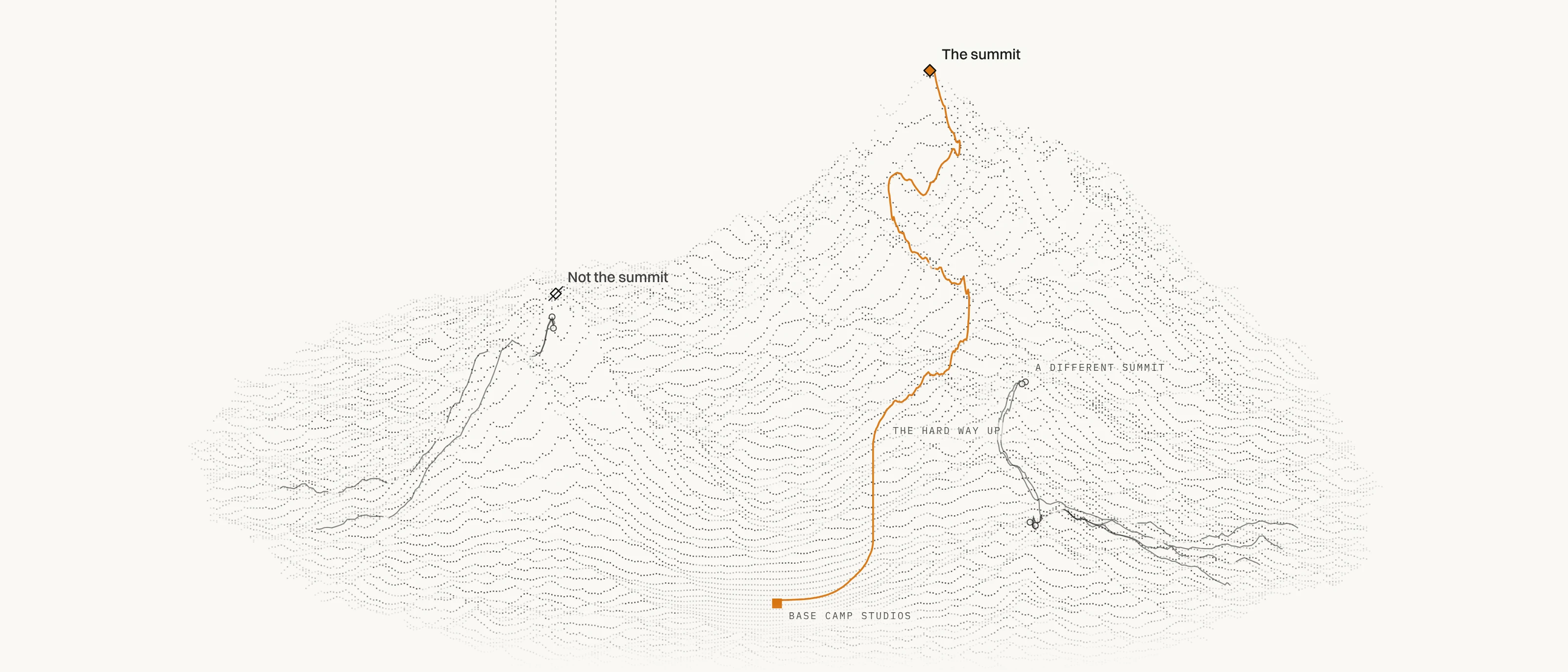
Used carelessly, AI takes the difficulty away, and with it the development that difficulty brings. It’s the helicopter to the top of Everest. You step out, look around, and only later find out it wasn’t Everest at all. You had no way of knowing, because you hadn’t done the work that would have told you the ground under your feet wasn’t what you were aiming for.
Writing a brief is meant to be hard. It’s part of what we do with you, and working through that difficulty together is where we find out what the problem really is. Skip it, hand it to AI or rush it, and you’ll still get to something that looks like the top. Only doing the work tells you whether it’s the summit you meant.
What to send us instead
Send us the mess. The rougher the better:
- the email you’d write to a friend about what’s wrong;
- a voice note recorded on a walk;
- the old deck, the half-finished document, the notes from the board meeting;
- the websites, films and brands you love, and the ones you can’t stand;
- the thing that’s been bothering you about the business, even if it doesn’t seem relevant;
- half an hour with the person whose name is on the company.
If you’ve already used AI to pull your thoughts together, that’s fine. Just send us what you gave it as well. It’s now part of how we work, in our terms of engagement.
Our brief form asks a few plain questions for the same reason. Answer them in your own words, and we’ll take it from there.
Charlie Smith
Base Camp Studios
Filed under Notes · Written by Charlie
Got something half-formed?
Send it as it is: the notes, the voice memo, the old deck. We’ll work out the brief with you.
Charlie reads every brief and replies himself