Securing Frontier Minerals
A visual language for a critical-minerals platform whose model is still being written: four figures, built in code, that explain it and can change with it.
The model keeps moving. The figures were built to move with it.
Overview
Securing Frontier Minerals is building an operator-led platform to originate, acquire and support producing critical-mineral assets in frontier markets. The model brings together new technology, people on the ground and layers of data, and it has to read clearly to technology investors. Base Camp has worked across the Alma Risk group's brands since 2023. In October 2026 it rebuilt SFM's microsite around a set of interactive figures.
Outcome
Concept to working build in about four days, with the microsite and business cards delivered within the fortnight.
Challenge
SFM works where technology, defence and extraction meet, and its specification is still moving. The model combines new technology, relationships on the ground and several layers of data, and it develops as the business does. The brand had to keep pace with that, and still make sense to the people funding it: technology investors, including defence-technology funds, who think in stacks and systems rather than in mines.
The argument is abstract. A mineral asset's value depends on conditions a spreadsheet doesn't show: who owns it, the relationships with government and community, security, and the route to market. SFM's first site, from September 2025, described the business broadly. A year on, it needed to show how the model works.
Role
- Brief to concept in a day: the call on 12 October 2026, a concept on 13 October.
- Information design, with one figure for each step of the argument.
- Four figures written as code: WebGL shaders and scroll-driven CSS.
- Webflow build for layout and content.
- Business cards to match.
A system, not a set of pictures
A brief that keeps changing can't be answered with fixed illustrations. So the brand is a drawing language rather than a set of images: fine line work, monospaced labels, a muted mineral palette and a single copper accent that always marks the asset.
Each figure is written as code and drawn from parameters, and every label is live text. When the model changes, the figures change with it, without starting again.
Fig. 01 · Terrain
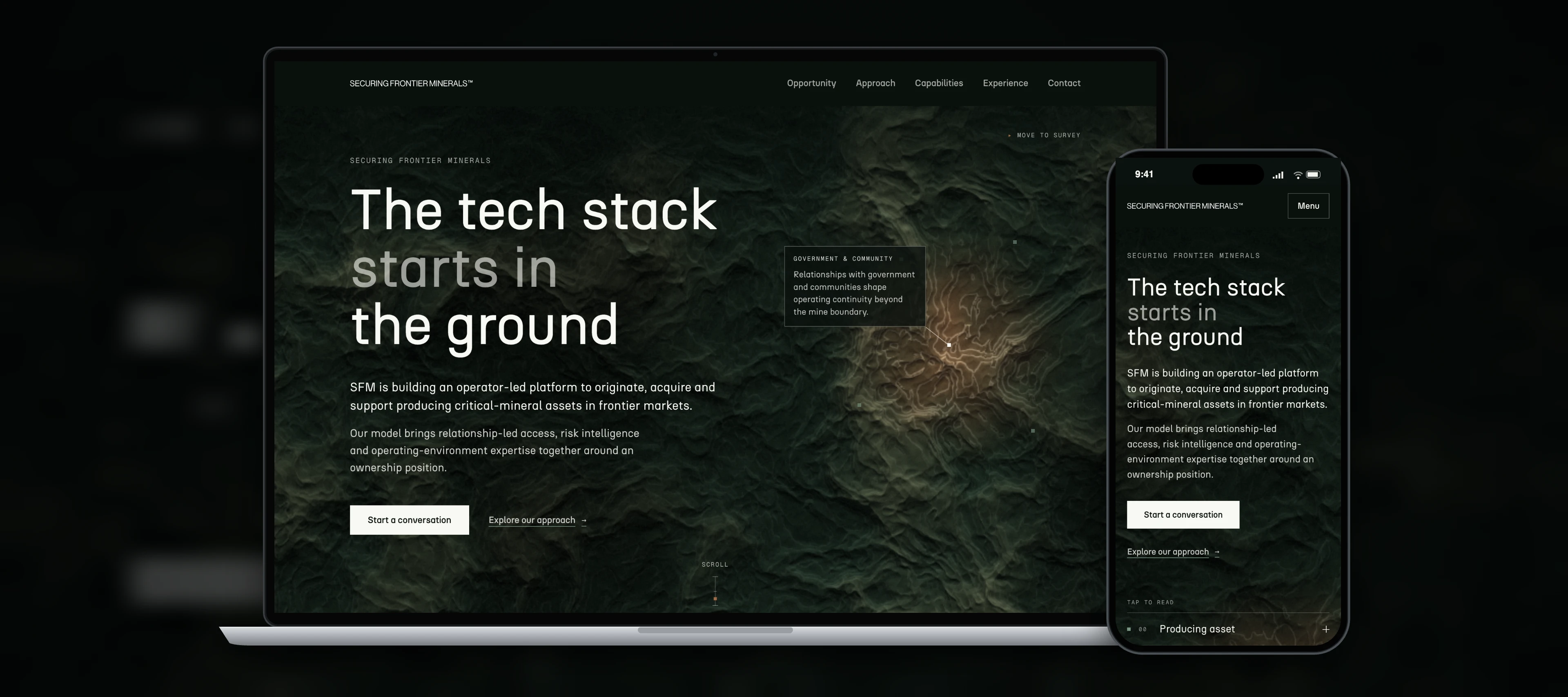
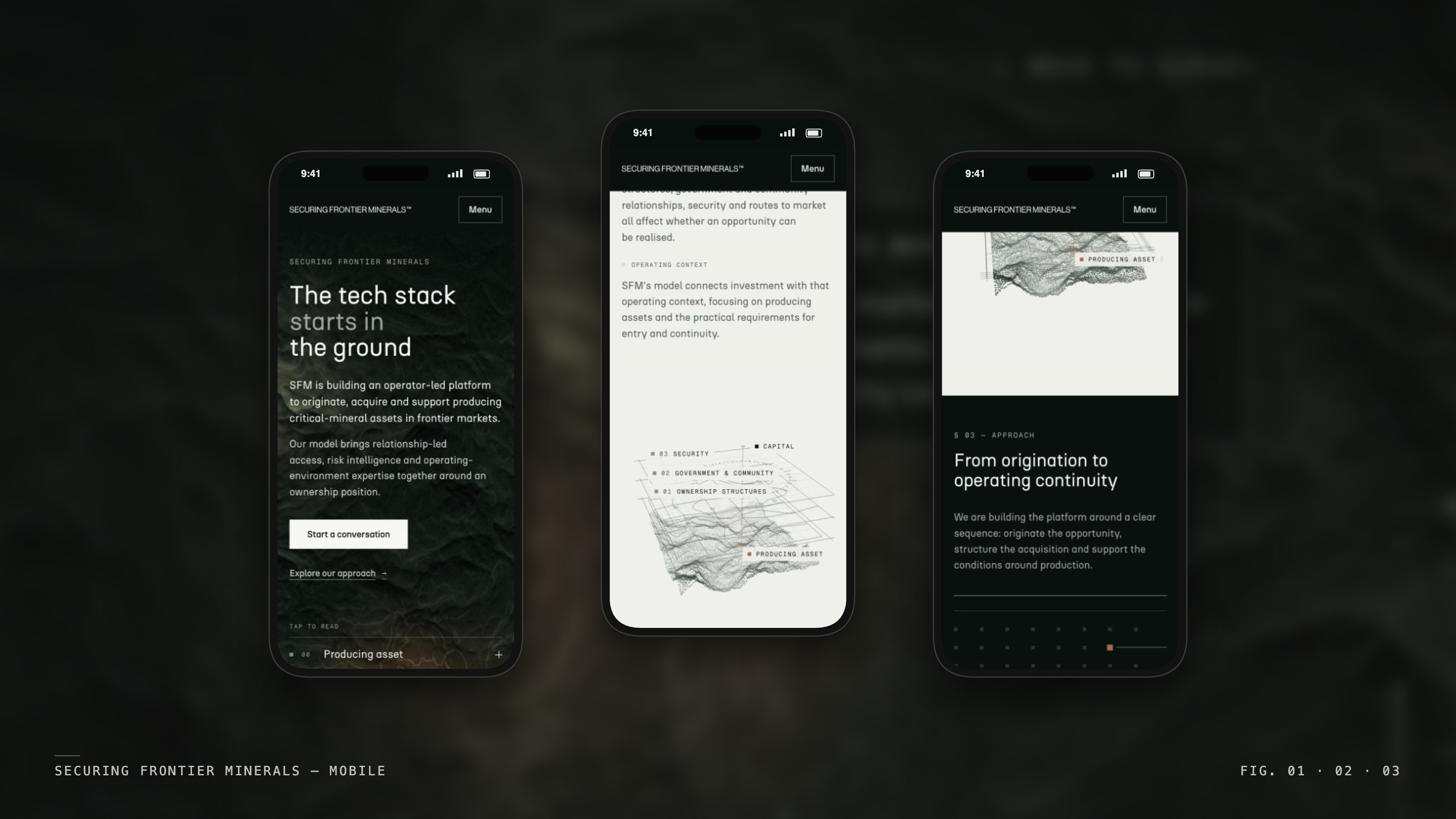
The site opens on the ground itself: a generated landscape with contour lines and drifting cloud shadow. Hotspots open short notes on the producing asset and the conditions around it. The line above it sets the frame for a technology investor: the tech stack starts in the ground.
Fig. 02 · Conditions
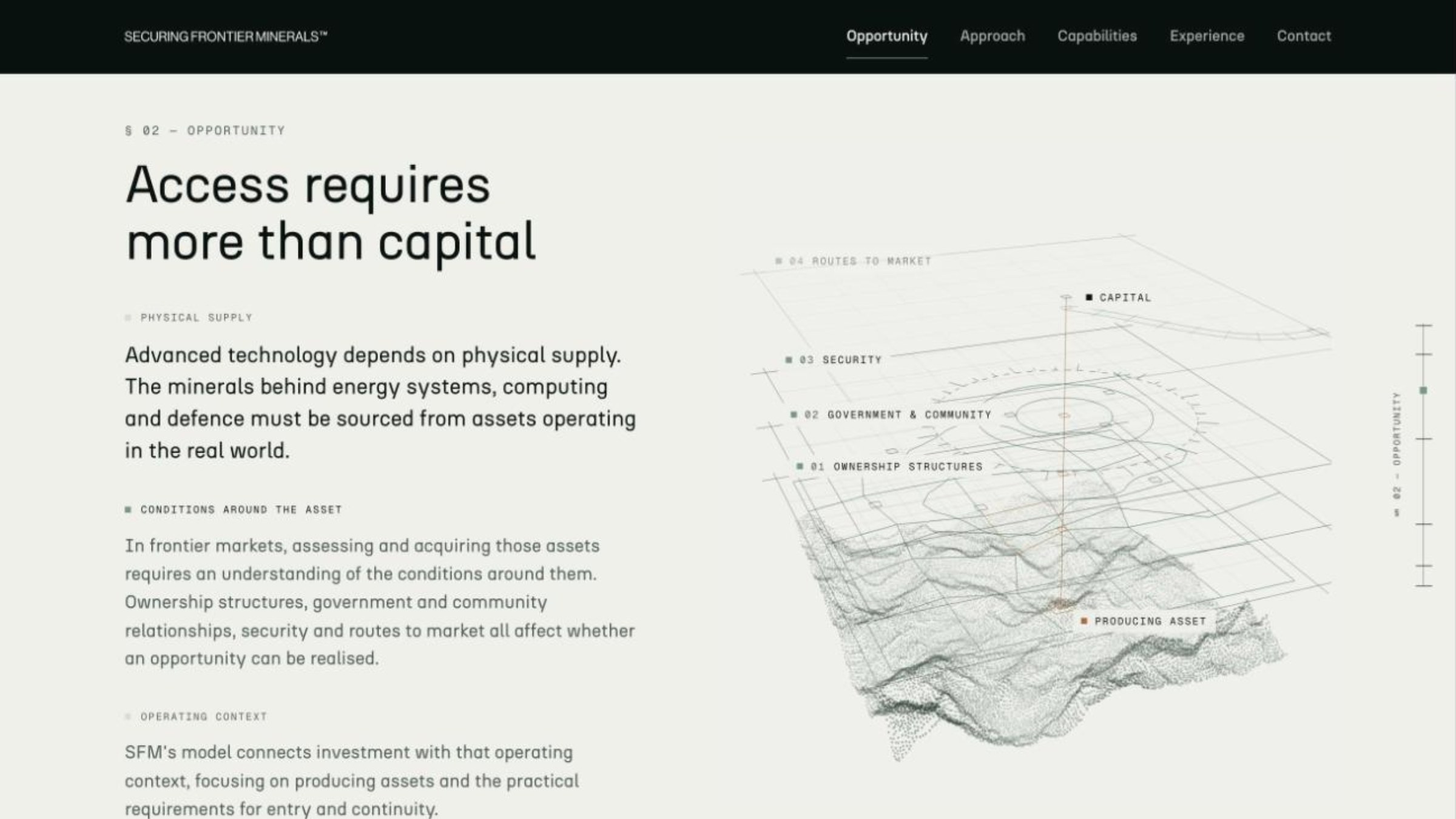
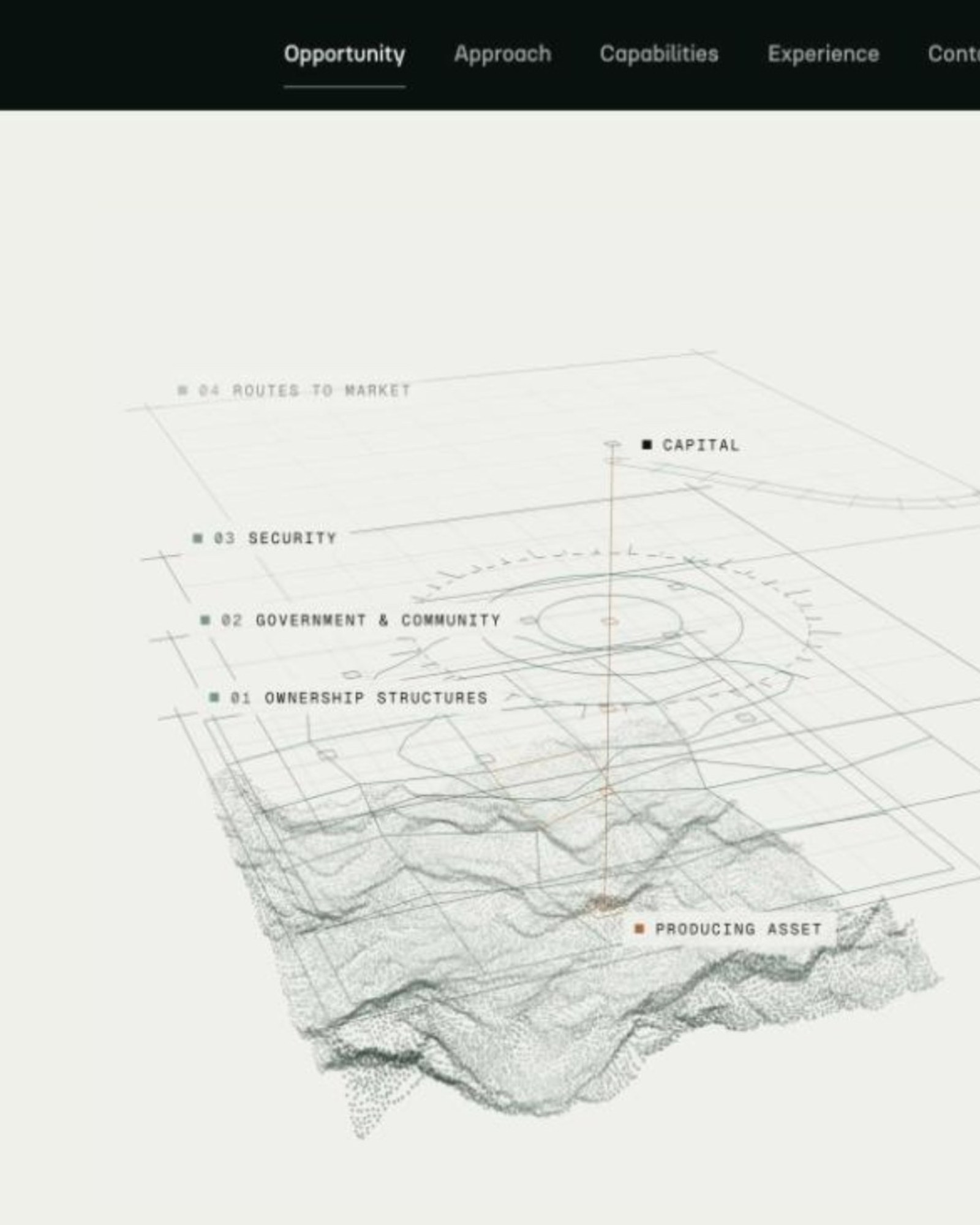
The core of the argument. A point-cloud terrain holds a single producing asset. As you scroll, the conditions around it stack up as layers of data: ownership structures, government and community, security, routes to market. Then they settle into one plate, investment and operating context. In one movement it shows why access takes more than capital.
Fig. 03 · Approach
SFM's sequence in three moves. A field of sourced opportunities narrows to one, an ownership position is taken alongside capital partners, and a specialist operator is placed around the asset. Scrolling drives it, so the reader sets the pace.
Fig. 04 · Strata
The experience behind the model, laid down like rock: frontier resource transactions in Africa, military operations, and advisory work with governments, extractive companies and humanitarian organisations, over a bed of complex environments. A core sample follows the cursor and reads each layer.
On every screen
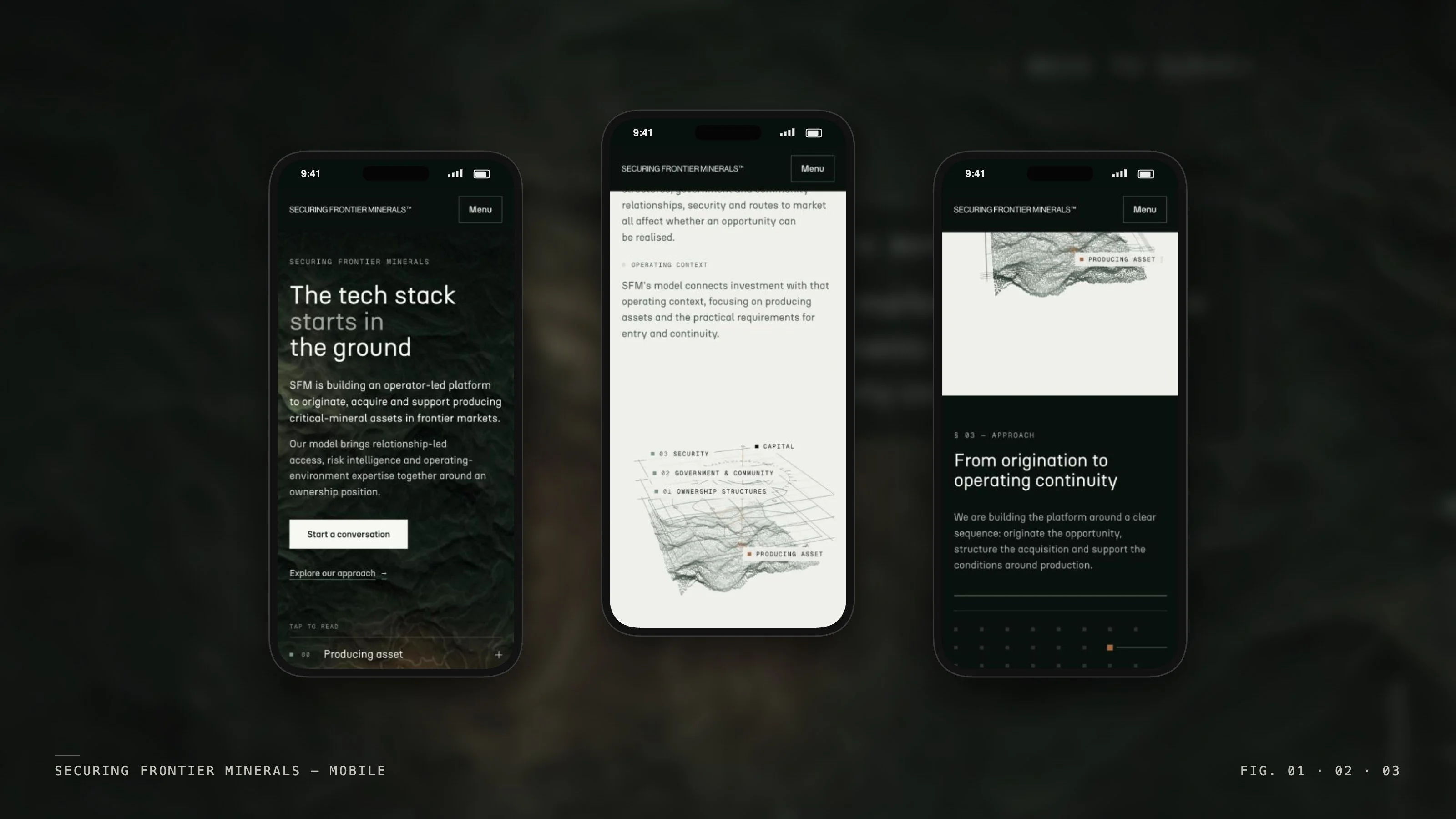
The figures are built for the phone as much as the desktop. Each one respects reduced-motion settings and falls back cleanly if WebGL isn't available. Webflow handles layout and content; the figures are written as code.
01 — Challenge
SFM works where technology, defence and extraction meet, and its specification is still moving. The model combines new technology, relationships on the ground and several layers of data, and it develops as the business does. The brand had to keep pace with that, and still make sense to the people funding it: technology investors, including defence-technology funds, who think in stacks and systems rather than in mines.
The argument is abstract. A mineral asset's value depends on conditions a spreadsheet doesn't show: who owns it, the relationships with government and community, security, and the route to market. SFM's first site, from September 2025, described the business broadly. A year on, it needed to show how the model works.
02 — Role
- Brief to concept in a day: the call on 12 October 2026, a concept on 13 October.
- Information design, with one figure for each step of the argument.
- Four figures written as code: WebGL shaders and scroll-driven CSS.
- Webflow build for layout and content.
- Business cards to match.
03 — Approach
Each section has a figure that carries its part of the argument, so a reader can follow the model without reading every line.
- Fig. 01, terrain. A generated landscape with contour lines and drifting cloud shadow. Hotspots open short notes on the producing asset and the conditions around it.
- Fig. 02, conditions. A point-cloud terrain. As you scroll, layers stack up around a producing asset: ownership structures, government and community, security, routes to market. Then they settle into one plate.
- Fig. 03, approach. A scroll-driven sequence: originate, acquire, support production.
- Fig. 04, strata. Rock beds and a core sample that follows the cursor, laying out the experience behind the model layer by layer.
Every label is live text rather than part of an image, and each figure is drawn from parameters, so the figures can follow the model as it changes. Each one respects reduced-motion settings and falls back cleanly without WebGL.
Identity
04 — Outcome
Concept to working build took about four days in October 2026, and the microsite and business cards were delivered within the fortnight. Because the figures are code and the words are live text, the site can move with the model rather than being redrawn each time it changes.
Credits
Project Description
Securing Frontier Minerals is building an operator-led platform to originate, acquire and support producing critical-mineral assets in frontier markets. The model brings together new technology, people on the ground and layers of data, and it has to read clearly to technology investors. Base Camp has worked across the Alma Risk group's brands since 2023. In October 2026 it rebuilt SFM's microsite around a set of interactive figures.
Client
Securing Frontier Minerals — Microsite
Date
2025–2026
Services
Brand / Information Design / Creative Code / Webflow
Sector
Critical minerals / Investment
The work. What we did, and what it changed.
SFM works where technology, defence and extraction meet, and its specification is still moving. The model combines new technology, relationships on the ground and several layers of data, and it develops as the business does. The brand had to keep pace with that, and still make sense to the people funding it: technology investors, including defence-technology funds, who think in stacks and systems rather than in mines.
The argument is abstract. A mineral asset's value depends on conditions a spreadsheet doesn't show: who owns it, the relationships with government and community, security, and the route to market. SFM's first site, from September 2025, described the business broadly. A year on, it needed to show how the model works.
- Brief to concept in a day: the call on 12 October 2026, a concept on 13 October.
- Information design, with one figure for each step of the argument.
- Four figures written as code: WebGL shaders and scroll-driven CSS.
- Webflow build for layout and content.
- Business cards to match.
Each section has a figure that carries its part of the argument, so a reader can follow the model without reading every line.
- Fig. 01, terrain. A generated landscape with contour lines and drifting cloud shadow. Hotspots open short notes on the producing asset and the conditions around it.
- Fig. 02, conditions. A point-cloud terrain. As you scroll, layers stack up around a producing asset: ownership structures, government and community, security, routes to market. Then they settle into one plate.
- Fig. 03, approach. A scroll-driven sequence: originate, acquire, support production.
- Fig. 04, strata. Rock beds and a core sample that follows the cursor, laying out the experience behind the model layer by layer.
Every label is live text rather than part of an image, and each figure is drawn from parameters, so the figures can follow the model as it changes. Each one respects reduced-motion settings and falls back cleanly without WebGL.
Concept to working build took about four days in October 2026, and the microsite and business cards were delivered within the fortnight. Because the figures are code and the words are live text, the site can move with the model rather than being redrawn each time it changes.
The model keeps moving. The figures were built to move with it.
“The work wasn't just about making it look better — it was about building a clearer relationship between product, story and experience.”
Related Work — More from the studio. Selected projects where brand, design, and performance move as one.


Shackleton × Defender — Rally Partnership
Partnership Strategy / Concept / Production / Creative Direction
Shackleton — Made to Move
Campaign Concept / Production / Talent / Creative Direction
Shackleton — The Exploration System
Brand Strategy / Product Strategy / System Design / Creative Direction